NSFW terminology refers to online words, labels, and abbreviations used to identify content that may be inappropriate or unsuitable for viewing at work, school, or in public. The best-known example is NSFW, meaning “Not Safe For Work.”
Key Takeaways
- NSFW stands for “Not Safe For Work” and is an internet abbreviation.
- It acts mainly as a content warning before a link, image, video, post, or message.
- NSFW can refer to adult material, nudity, profanity, graphic imagery, or other content someone may not want displayed publicly.
- “NSFW terminology” is broader than one abbreviation; it can include related labels such as SFW and NSFL.
- The label describes the viewing situation rather than automatically describing one specific type of content.
- Because it is informal internet language, NSFW is generally more appropriate for online communities than formal workplace communication.
NSFW Terminology Meaning in Text
In texting and online communication, NSFW terminology refers to shorthand and warning labels that tell someone content may not be appropriate to open in a workplace, classroom, family setting, or other public environment.
The central term is NSFW, an internet acronym meaning “Not Safe For Work.” It can appear before a link, photo, video, post, joke, message, or discussion as a warning to check the content privately.
For example:
“NSFW — open this later.”
The sender is essentially saying, “Be careful where you view this.”
Although NSFW is often associated with sexual or adult material, the label can also be used for profanity, graphic imagery, offensive material, or other content considered unsuitable for a professional or public setting.
What Does NSFW Stand For?
NSFW stands for “Not Safe For Work.”
Another recognized wording is “Not Suitable For Work.” Both expressions communicate the same basic idea: the content may not be appropriate to view in a workplace or another setting where privacy is important.
The abbreviation is useful because it gives readers a quick warning without requiring a long explanation.
How Is NSFW Terminology Used?
NSFW terminology is commonly used in digital communication when someone wants to flag potentially inappropriate or sensitive material before another person opens it.

In Text Messages
A person might write:
“NSFW link — wait until you get home.”
This warns the recipient that opening the link publicly could be awkward or inappropriate.
In DMs and Group Chats
Friends may use NSFW before sending a questionable meme, image, video, or joke.
“NSFW 😂”
The exact content depends on the conversation, so the label itself does not identify precisely what is inside.
On Social Media
NSFW can appear in captions, comments, posts, usernames, community labels, or content warnings. It is particularly useful when people want others to know that a post may not be suitable for public viewing.
In Online Communities and Forums
NSFW is also used as a warning or category label for posts containing sensitive material. It can help readers decide whether they want to open the content.
In Gaming and Online Chats
The abbreviation can be used conversationally when a screenshot, joke, voice-chat comment, or shared link contains material that may not be appropriate around other people.
Real Chat Examples
Here are natural examples showing different ways NSFW terminology can appear in online conversations:
- Friend: “I found the original video. NSFW though.”
You: “I’ll check it later.” - Friend: “NSFW link 😂”
You: “Thanks for the warning.” - Coworker: “That meme is probably NSFW.”
You: “Good call. I won’t open it here.” - Friend: “Don’t open this at work. NSFW.”
You: “Got it.” - Group chat: “Posting this with an NSFW warning.”
Reply: “Appreciated.” - DM: “I’ll send the NSFW version separately.”
Reply: “Okay, send it when appropriate.” - Friend: “This thread gets NSFW pretty quickly.”
Reply: “I’ll keep that in mind.” - Social media comment: “NSFW warning before you scroll.”
Reply: “Thanks for the heads-up.” - Discord chat: “That channel is NSFW.”
Reply: “Understood.” - Friend: “NSFW meme incoming.”
Reply: “I’m not opening that in public 😂” - Group chat: “Marking this NSFW just in case.”
Reply: “Fair enough.” - Friend: “This photo might be NSFW.”
Reply: “I’ll wait until I’m somewhere private.” - DM: “NSFW content ahead.”
Reply: “Thanks for warning me.” - Forum user: “This post should probably be tagged NSFW.”
Reply: “Agreed.” - Friend: “Definitely NSFW lol.”
Reply: “That tells me enough.” - Chat: “Is this safe to open here?”
Reply: “Nope, NSFW.” - Friend: “I have a funny but NSFW clip.”
Reply: “Send it later.” - Group chat: “NSFW warning ⚠️”
Reply: “Noted.”
How to Reply to NSFW
Your response depends on whether the sender is simply warning you, asking permission to send something, or sharing content you do not want to view.
Casual Replies
- “Got it.”
- “Thanks for the warning.”
- “I’ll check it later.”
- “Noted.”
Friendly Replies
- “Appreciate the heads-up.”
- “Good looking out.”
- “Thanks for letting me know.”
- “I’ll open it somewhere private.”
Funny Replies
- “My workplace thanks you 😂”
- “Definitely saving that for later.”
- “Not opening that in the office 😅”
- “Warning received.”
Neutral Replies
- “Understood.”
- “Okay, I’ll wait.”
- “Thanks for letting me know.”
- “I’ll view it later.”
Flirty/Relationship Replies
If NSFW appears in a conversation with a crush or partner, the label still does not automatically mean the sender is flirting. Context matters.
Possible responses include:
- “Okay, I’ll look when I’m somewhere private.”
- “Thanks for the warning.”
- “You definitely made me curious 😂”
- “I’ll check it later.”
Context & Relationship Meaning
NSFW has the same basic definition regardless of whether it comes from a guy, girl, friend, crush, or partner.
For example, if someone says:
“I’m sending you something NSFW.”
The important information is the warning about the content. The phrase alone does not prove romantic interest, attraction, flirting, or sexual intent.
Context can change how the message feels. A close friend might use NSFW casually, while a romantic partner might use it when discussing private material. Punctuation, emojis, previous messages, and the relationship between the people can all affect the tone.
What Tone Does NSFW Have?
NSFW is usually informational, cautionary, or casual.
Depending on the conversation, it can sound:
- Neutral: “NSFW warning.”
- Cautionary: “Don’t open this at work. NSFW.”
- Playful: “This meme is NSFW 😂”
- Matter-of-fact: “The post contains NSFW material.”
- Teasing: “I found an NSFW version.”
The abbreviation itself does not determine whether the sender is being serious or playful.
Is NSFW Rude or Offensive?
The abbreviation NSFW is not inherently rude or offensive. It is primarily a warning label.
However, the content being labeled NSFW may be sexual, graphic, profane, offensive, or otherwise unsuitable for a particular setting.
For casual texting and online communities, NSFW is generally understandable. In professional communication, a clearer description such as “contains sensitive material” may be more appropriate when the audience needs formal wording.
Other Meanings of NSFW
NSFW has a closely related alternative wording:
Not Suitable For Work
“Not Suitable For Work” communicates essentially the same idea as “Not Safe For Work.” Both are used as warnings about content that may be inappropriate in a workplace or public setting.
SFW
SFW means “Safe For Work.” It is commonly used as the opposite of NSFW when content is considered suitable for viewing in ordinary public or professional settings.
NSFL
NSFL means “Not Safe For Life.” It is used online for extremely disturbing or graphic material and is stronger than an ordinary NSFW warning.
NSFW vs. Similar Slang
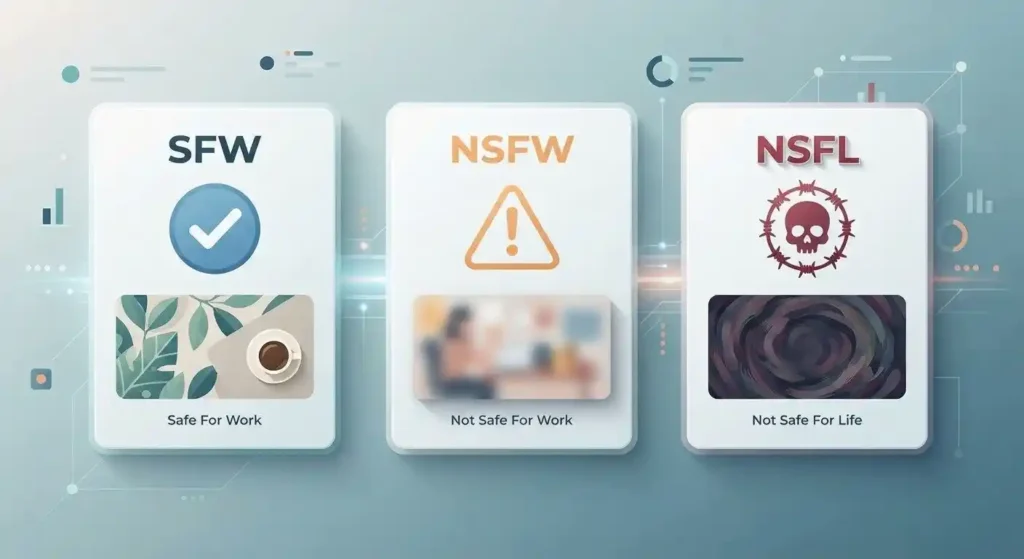
| Term | Meaning | Difference |
|---|---|---|
| NSFW | Not Safe For Work | Warns that content may be inappropriate for work or public viewing |
| SFW | Safe For Work | Indicates content is generally suitable for public or workplace viewing |
| NSFL | Not Safe For Life | Stronger warning for extremely disturbing or graphic material |
| NFSW | Usually a typo for NSFW | The letters are commonly reversed accidentally |
The important distinction is that NSFW is a general content warning, not a precise description of what the content contains.
Common Mistakes About NSFW
Assuming NSFW Always Means Porn
NSFW is often associated with sexual or adult material, but it can also describe graphic, offensive, profane, or otherwise inappropriate content.
Thinking NSFW Means Dangerous
The label does not necessarily mean that something is physically dangerous. It mainly warns that the material may be inappropriate to view in a particular environment.
Assuming It Proves Romantic Intent
If someone sends an NSFW warning, that alone does not prove they are flirting or interested in you romantically.
Confusing NSFW With NSFL
NSFL is a substantially stronger warning associated with extremely disturbing material, while NSFW is a broader label for content unsuitable for certain settings.
Treating It as Formal Language
NSFW is internet shorthand. It works naturally in chats, forums, DMs, and social media but may not be the best wording for formal workplace communication.
Related Internet Slang
| Term | Meaning | Common Use |
|---|---|---|
| SFW | Safe For Work | Labeling content as suitable for public or workplace viewing |
| NSFL | Not Safe For Life | Warning about extremely disturbing material |
| TW | Trigger Warning | Alerting readers to potentially distressing subject matter |
| CW | Content Warning | General warning about potentially sensitive content |
| 18+ | Adults only | Indicating that content is intended for adults |
| NSFW | Not Safe For Work | Warning about potentially inappropriate or sensitive content |
Real-World Conversation
Alex: “Can you check this link?”
Sam: “Sure.”
Alex: “NSFW, though. Don’t open it at work.”
Sam: “Got it. I’ll check it when I’m home.”
Here, NSFW works as a simple warning. Alex is not necessarily describing the content in detail; the label tells Sam to consider the setting before opening it.
People Also Ask
What does NSFW mean in texting?
NSFW means “Not Safe For Work.” In texting, it is generally used as a warning that a photo, video, link, joke, message, or other material may not be appropriate to view in a workplace or public setting.
What does NSFW mean on social media?
On social media, NSFW is a content warning. It can indicate that a post or link contains adult, graphic, profane, offensive, or otherwise sensitive material.
Does NSFW always mean sexual?
No. Sexual or adult content is one common reason for an NSFW label, but the term can also apply to graphic images, profanity, offensive material, or other content unsuitable for a particular environment.
What is the opposite of NSFW?
SFW, meaning “Safe For Work,” is commonly used as the opposite. It indicates that content is generally appropriate for viewing in public or professional settings.
What does NSFW mean from a guy or girl?
The definition does not change based on the sender’s gender. Whether an NSFW message has a playful, personal, or romantic tone depends on the surrounding conversation and relationship.
Is NSFW a warning?
Yes. Its primary purpose is to warn someone before they view content that may be inappropriate for work, school, family settings, or public places.
What does NSFL mean compared with NSFW?
NSFL means “Not Safe For Life” and is generally used for extremely disturbing or graphic content. It signals a stronger warning than ordinary NSFW labeling.
Is NSFW appropriate for work?
The abbreviation itself is harmless as a label, but NSFW content may not be appropriate for workplace viewing. If you receive an NSFW warning, it is sensible to wait until you are in a private and appropriate setting before opening the material.
Conclusion
NSFW terminology centers on online warning language, with NSFW (“Not Safe For Work”) being the main term. It tells people that content may be inappropriate for work, school, public places, or other shared environments. The label can cover adult material as well as graphic, profane, offensive, or sensitive content. Context determines the exact meaning and tone, while related terms such as SFW, NSFL, TW, and CW provide more specific warnings.

Michael Anderson writes pun and joke articles built around clever wordplay, covering food, animals, seasons, technology, entertainment, and trending topics. Across 3.5 years of experience, he has refined punchlines by comparing wording, shaping joke collections, and polishing phrasing for clarity and flow. His work focuses on keeping each pun fresh, well-structured, and suited to its theme.