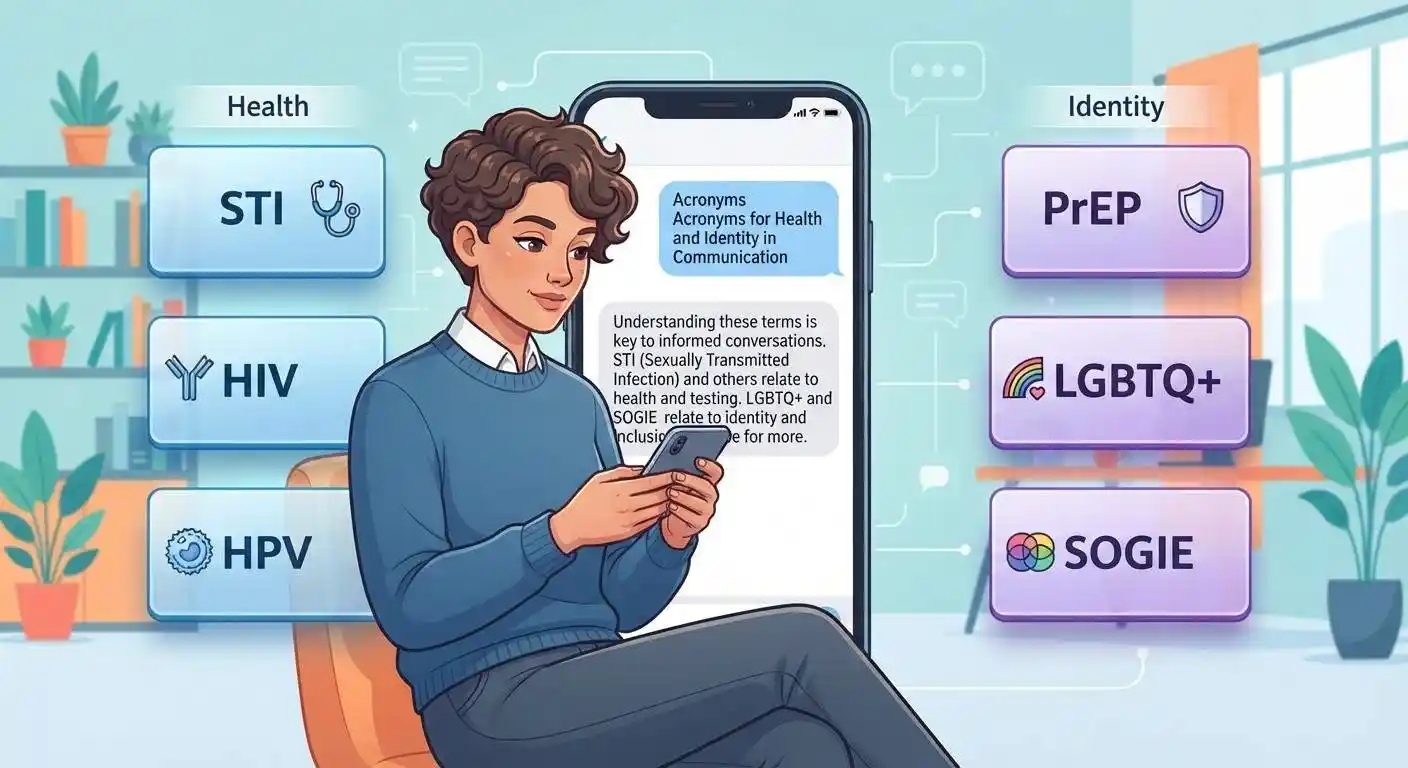
Sexual acronyms are shortened terms used when discussing sexual health, sexuality, gender, relationships, and related topics. Some are medical or educational, while others describe identity or health concepts.
Key Takeaways
- Sexual acronyms can relate to sexual health, reproductive health, gender, sexuality, and relationships.
- Common health-related examples include STI, HIV, HPV, PrEP, and PEP.
- LGBTQ+ and related terminology can be used when discussing sexual orientation and gender identity.
- Not every acronym connected with sexuality is slang. Many are formal medical or educational terms.
- Context matters because some abbreviations can have different meanings in different fields.
- When an unfamiliar acronym appears in a message, asking what it means is better than guessing.
Sexual Acronyms Meaning in Text
The term “sexual acronyms” refers to abbreviations connected with sexuality, sexual health, gender, relationships, or related subjects.
There is no single full form for “sexual acronyms.” Instead, it describes a broad category of shortened terms.
For example:
- STI means sexually transmitted infection.
- HIV means human immunodeficiency virus.
- HPV means human papillomavirus.
- PrEP means pre-exposure prophylaxis.
- PEP means post-exposure prophylaxis.
- LGBTQ+ is an umbrella term for diverse sexual orientations and gender identities.
Some of these terms are medical, while others are used in education, social discussions, or conversations about identity.
Because the category includes several types of terminology, the meaning and tone depend on the particular acronym and the context in which it appears.
What Do Sexual Acronyms Stand For?
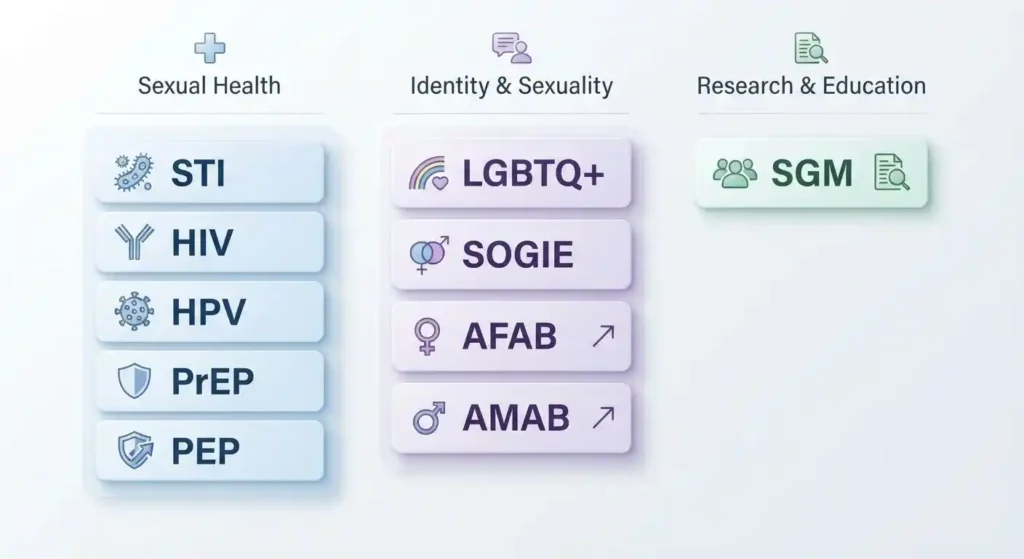
There is no single expansion for the phrase “sexual acronyms.” Each abbreviation has its own meaning.
Here are some important examples:
| Acronym | Full Form | General Context |
|---|---|---|
| STI | Sexually transmitted infection | Sexual health |
| HIV | Human immunodeficiency virus | Medical health |
| HPV | Human papillomavirus | Medical health |
| PrEP | Pre-exposure prophylaxis | HIV prevention |
| PEP | Post-exposure prophylaxis | HIV prevention |
| LGBTQ+ | Lesbian, gay, bisexual, transgender, queer or questioning, and other identities | Identity and community |
| SOGIE | Sexual orientation, gender identity, and expression | Education and identity |
| AFAB | Assigned female at birth | Gender terminology |
| AMAB | Assigned male at birth | Gender terminology |
| SGM | Sexual and gender minority | Health and social research |
These terms are not interchangeable. For example, STI is a health term, while LGBTQ+ is an identity-related umbrella term.
How Are Sexual Acronyms Used?
Sexual and sexuality-related acronyms can appear in several types of communication.

Text Messages
People may use health or identity terminology when discussing something they learned or want explained.
Example:
“Do you know what HPV means?”
DMs
A person might ask about an unfamiliar term:
“I keep seeing SOGIE. What does it mean?”
Group Chats
Acronyms can appear when people discuss school topics, health information, or general questions.
Social Media
Identity-related terms such as LGBTQ+ may appear in posts, comments, profiles, and educational discussions.
School and Educational Settings
Medical acronyms such as STI, HIV, and HPV are commonly encountered in health education.
In these situations, understanding the actual definition is more important than treating the acronym as internet slang.
Sexual Acronyms in Different Contexts
The meaning of an acronym depends on the conversation and the setting.
From a Friend
A friend might use an acronym after learning about it in class or seeing it in an article.
Example:
“My health class talked about STIs today.”
Here, the acronym has a straightforward educational meaning.
From a Guy
An acronym does not automatically have a different meaning because a guy uses it.
The topic and surrounding messages are more useful for understanding what he means.
From a Girl
The same applies when a girl uses an acronym. Gender does not change the standard definition of a medical or educational abbreviation.
From a Crush
If someone you have a crush on uses a sexuality-related acronym, do not automatically interpret it as flirting.
They could simply be discussing a health, identity, or educational topic.
In Dating
People may encounter terminology related to health, identity, boundaries, or relationships when talking about dating.
The acronym itself does not establish romantic intent.
In a Relationship
Partners may use health-related terminology when discussing general health or personal concerns.
Clear communication is especially useful if one person does not recognize the abbreviation.
In a Group Chat
Different people may understand the same acronym differently. If the context is unclear, asking for clarification can prevent misunderstandings.
In Social Media Comments
An acronym can have a medical, educational, identity-related, or unrelated meaning depending on the post.
Always consider the topic before interpreting it.
Real Chat Examples
Here are age-appropriate examples using health and identity terminology:
- “What does STI stand for?”
- “I saw HPV in my health textbook.”
- “Can someone explain what HIV means?”
- “What does PrEP mean?”
- “I heard about PEP in health class.”
- “What does LGBTQ+ stand for?”
- “I’ve seen AFAB online. What does it mean?”
- “What does AMAB mean?”
- “What does SOGIE mean?”
- “Is STI the same thing as STD?”
- “Why do people use the term STI?”
- “Can someone explain HPV in simple terms?”
- “I don’t know what that acronym means.”
- “What does SGM stand for?”
- “I found that abbreviation in a health article.”
- “Is that a medical abbreviation?”
- “What does LGBTQ+ mean in this conversation?”
- “Can you explain what PrEP is?”
- “I wasn’t familiar with that term.”
- “What does that acronym mean in this context?”
How to Reply to Sexual Acronyms
When someone uses an unfamiliar acronym, the simplest response is usually to ask what it means.
Casual Replies
- “What does that mean?”
- “I’ve never seen that abbreviation.”
- “What does it stand for?”
- “Can you explain it?”
Friendly Replies
- “I’m not familiar with that one.”
- “Can you explain what you mean?”
- “I want to make sure I understand.”
- “Where did you see that term?”
Funny Replies
For a light conversation:
- “Okay, I need an acronym dictionary.”
- “You lost me at the letters.”
- “Wait, what does that stand for?”
Neutral Replies
- “Could you clarify the abbreviation?”
- “What is the full term?”
- “Which meaning are you referring to?”
- “Is that a medical term?”
Relationship Replies
If the conversation involves personal boundaries or health, a clear question is better than guessing:
- “Can you explain what you mean?”
- “I want to make sure we’re talking about the same thing.”
- “Could you clarify that term?”
What Tone Do Sexual Acronyms Have?
The tone depends on the particular acronym and the situation.
Medical
Terms such as STI, HIV, HPV, PrEP, and PEP are primarily medical or health-related.
Educational
These abbreviations can appear in textbooks, health lessons, educational resources, and discussions about health.
Identity-Related
Terms such as LGBTQ+, SOGIE, AFAB, and AMAB can appear in discussions about identity and terminology.
Casual
Some acronyms may appear in everyday online conversations, but that does not automatically make them slang.
Context-Dependent
An abbreviation can have different meanings in different fields. Looking at the surrounding conversation can help identify the intended meaning.
Are Sexual Acronyms Rude or Offensive?
Sexual-health and identity-related acronyms are not inherently rude or offensive.
Terms such as STI, HIV, HPV, PrEP, and PEP are legitimate health terminology. LGBTQ+ and related terms are also used in educational and social contexts.
However, some sexuality-related abbreviations can refer to mature subjects. Those terms may not be appropriate for every audience or setting.
For school, work, or formal communication, clear and respectful language is usually preferable to unfamiliar slang or unexplained abbreviations.
Other Meanings of Sexual Acronyms
Sexual Health
Several commonly encountered acronyms are related to health:
- STI: sexually transmitted infection
- HIV: human immunodeficiency virus
- HPV: human papillomavirus
- PrEP: pre-exposure prophylaxis
- PEP: post-exposure prophylaxis
These terms are primarily used in medical and educational contexts.
Gender and Sexuality
Other terms relate to identity and social terminology:
- LGBTQ+
- SOGIE
- SGM
- AFAB
- AMAB
These terms can have specific meanings, and some terminology may vary between communities or organizations.
Acronyms With Multiple Meanings
Some abbreviations can mean different things in completely unrelated subjects.
For example, an acronym used in medicine may have another meaning in technology or business.
That is why context is important when interpreting an unfamiliar abbreviation.
Common Mistakes About Sexual Acronyms
Assuming Every Acronym Is Sexual
An abbreviation may have several unrelated meanings. The surrounding conversation helps determine which one applies.
Treating Medical Terms as Slang
STI, HIV, HPV, PrEP, and PEP are primarily health-related terms. They should not automatically be categorized as casual internet slang.
Assuming an Acronym Has Only One Meaning
Some abbreviations are used across multiple fields, so the same letters can represent different phrases.
Assuming an Acronym Shows Romantic Interest
Someone using a sexuality-related acronym is not automatically flirting or expressing romantic interest.
Assuming Gender Changes the Meaning
A guy or girl using an acronym does not change its standard definition.
Guessing Instead of Asking
If you do not recognize an acronym, asking “What does that mean?” is usually more accurate than making an assumption.
Confusing Health Terms With Slang
A medical abbreviation and an informal online abbreviation may look similar but have completely different meanings.
Sexual Acronyms and Related Terms
| Term | Meaning | Common Use |
|---|---|---|
| STI | Sexually transmitted infection | Sexual health |
| HIV | Human immunodeficiency virus | Medical health |
| HPV | Human papillomavirus | Medical health |
| PrEP | Pre-exposure prophylaxis | HIV prevention |
| PEP | Post-exposure prophylaxis | HIV prevention |
| LGBTQ+ | Umbrella term for diverse sexual orientations and gender identities | Identity and community |
| SOGIE | Sexual orientation, gender identity, and expression | Education and identity |
| AFAB | Assigned female at birth | Gender terminology |
| AMAB | Assigned male at birth | Gender terminology |
| SGM | Sexual and gender minority | Health and social research |
| NSFW | Not safe for work | Online content warning |
People Also Ask About Sexual Acronyms
What are sexual acronyms?
Sexual acronyms are shortened terms connected with sexual health, sexuality, gender, relationships, or related subjects. They can be medical, educational, identity-related, or informal.
What does STI stand for?
STI stands for “sexually transmitted infection.” It is a medical term used for infections that can be transmitted through sexual contact.
What does LGBTQ+ stand for?
LGBTQ+ is an umbrella acronym covering lesbian, gay, bisexual, transgender, queer or questioning, and other sexual and gender identities.
What does HPV stand for?
HPV stands for “human papillomavirus.” It refers to a group of viruses that can affect different parts of the body, including areas relevant to sexual health.
What does PrEP stand for?
PrEP stands for “pre-exposure prophylaxis.” It refers to medication used to help prevent HIV infection in people who may be exposed to HIV.
What does PEP stand for?
PEP stands for “post-exposure prophylaxis.” It refers to medication used after a possible exposure to HIV and is intended to reduce the chance of infection.
Why do people use sexual acronyms?
Acronyms can make long medical, educational, or identity-related terms easier to communicate. They can also make repeated terminology more concise.
How can I understand an unfamiliar sexual acronym?
Look at the surrounding conversation and determine whether the topic is medical, educational, identity-related, or something else. If it remains unclear, asking the person to spell out the acronym is the most reliable approach.
Conclusion
Sexual acronyms are shortened terms used in discussions about sexual health, sexuality, gender, relationships, and related subjects. They are not all slang, and they do not all have the same purpose.
Medical terms such as STI, HIV, HPV, PrEP, and PEP are mainly used in health and educational settings. LGBTQ+, SOGIE, AFAB, and AMAB are examples of terminology used when discussing identity and related concepts.
Because abbreviations can have multiple meanings, context is important. A sexuality-related acronym does not automatically indicate flirting, romantic interest, or anything inappropriate.
When you encounter an unfamiliar acronym, the clearest approach is to consider the context or simply ask what it means.

Mila Parker brings three years of writing experience to the craft of puns, jokes, and concise wordplay. Her subject range moves through food, animals, seasonal themes, technology, entertainment, and trending topics. She studies relevant terminology, connects words through double meanings and associations, then adjusts setups and punchlines to keep each joke clear and well structured.